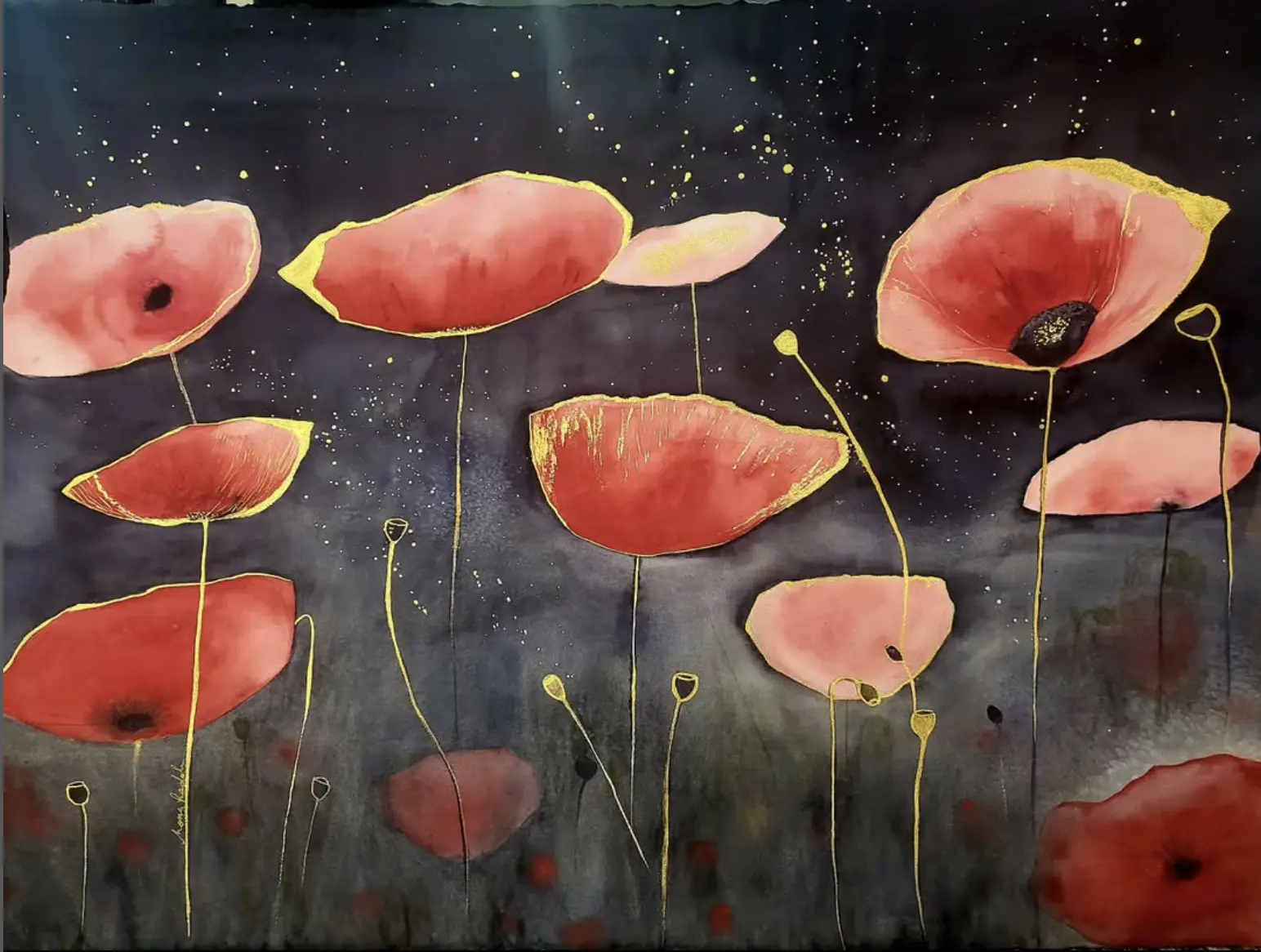
Blooming Under Siege by Mona Kadah
Indigenous Truthtelling Project
Grounded in a commitment to Indigenous knowledge keeping, our project brings together movements in solidarity against colonial oppression, ethnic cleansing, scholasticide, and genocide. Engaging both virtual and physical landscapes, our project honors and memorializes Palestinian and Indigenous knowledge keepers – journalists, educators, writers, culture workers, and poets – those resisting and martyred in their Indigenous homelands.
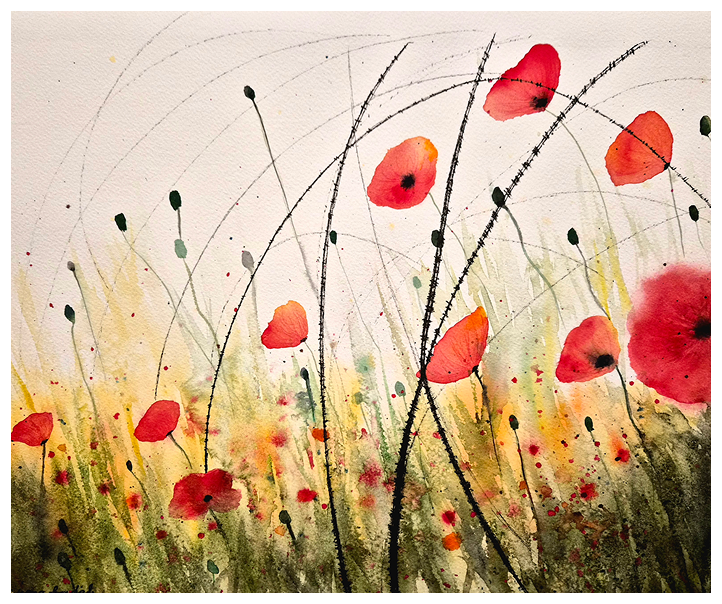
Poppies in Palestine, a series, by Monah Kadah
About the Indigenous Truthtelling Project
Indigenous Truthtelling brings together past and ongoing legacies of resistance to colonialism to educate about Indigenous resistance movements - with distinct homelands, languages and cultures – including Indigenous residents of Turtle Island and the Palestinian shatat, diaspora, as well as their co-strugglers.
Recognizing the ongoing anti-colonial struggles of Indigenous people around the world, we envision this as one step toward a shared liberated horizon.
We hope that teachers, educators, students, laity, community members and people of conscience will share and educate others with these artistic pieces, poems and mosaics.
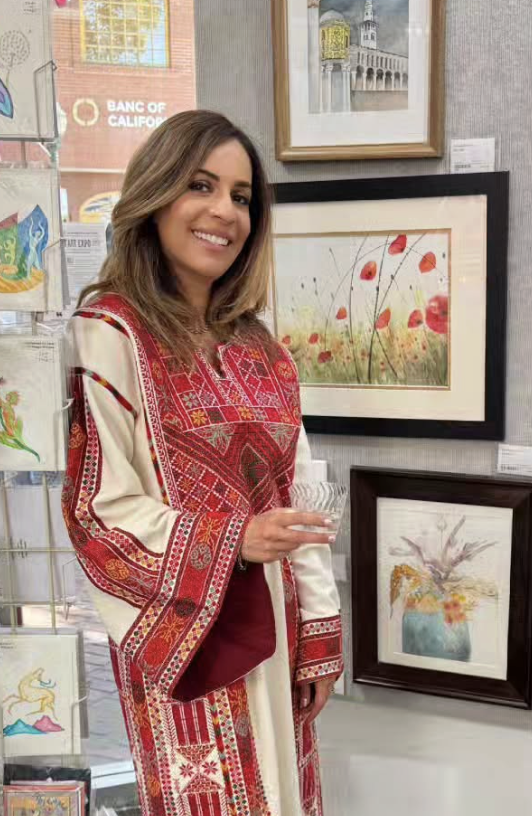
Mona
Kadah
@monakadahart
Mona Kadah is a Palestinian American watercolor artist with roots in traditional Damascene painting. Inspired-by California’s landscapes and her Palestinian cultural roots, Mona creates both vivid landscapes and abstract pieces centered on identity, beauty and memory. She has also been involved in community cultural work through the Dabkeh dance group Zaytouna in San Diego.
Currently, she is developing new collections featuring abstract Arabic words and floral paintings from her garden, and architectural sites. Her work has earned numerous awards, including First Place at the 2025 Yucaipa Valley Art Association Spring & Art Festival, First Place at the Coachella Valley Watercolor Society (2021), and the Demonstrator’s Choice Award (2024). She was also juried into the 108th National Orange Show Art exhibit.
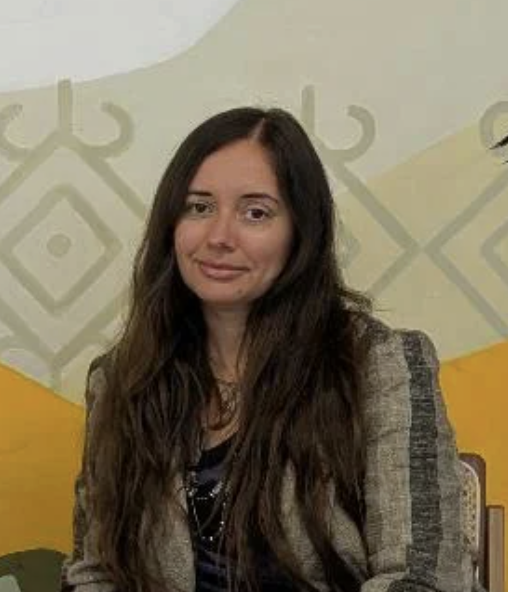
Weshoyot Alvitre is a Tongva and Scottish comic book artist, writer and illustrator. She was born in the Santa Monica Mountains on the property of Satwiwa, a cultural center started by her father Art Alvitre. She grew up close to the land and raised with traditional knowledge that inspires the work she does today.
Weshoyot has been working in the comics medium for over 15 years. Her work focuses on art and writing that visualizes historical material through an Indigenous lens. She has also contributed art response to contemporary Indigenous issues using pop-culture, sci-fi and archival research materials to spark conversations and re-frame colonial narratives.
Her work has been featured in the anthologies of Moonshot Volumes 2 and 3, Deerwoman: An anthology, Imminent Cuisine the Zine, and Marvel Voices: Indigenous Voices. Alvitre has also received numerous awards for her childrens book illustrations in 'At The Mountains Base' (Kokila 2019) and 'Living Ghosts & Mischeivous Monsters' (Scholastic 2021).
Alvitre’s current projects 'Toypurina: Our Lady of Sorrows' and 'Lone' focus on the re-telling of stories from her own tribal community, using historical fact, primary accounts and tribal knowledge to provide fuller representation of those from her Tongva history. Alvitre has made a conscious choice to work primarily within Native-owned publications and educational avenues, to further support a self-funded narrative on past, present and future native issues. It is through this voice, and through her artwork, she feels she is able to communicate her unique viewpoint and continue a strong dialogue on issues that are important to her as a Native woman.
Refaat Alareer: The Legacy of Gaza's Grand Storytellers
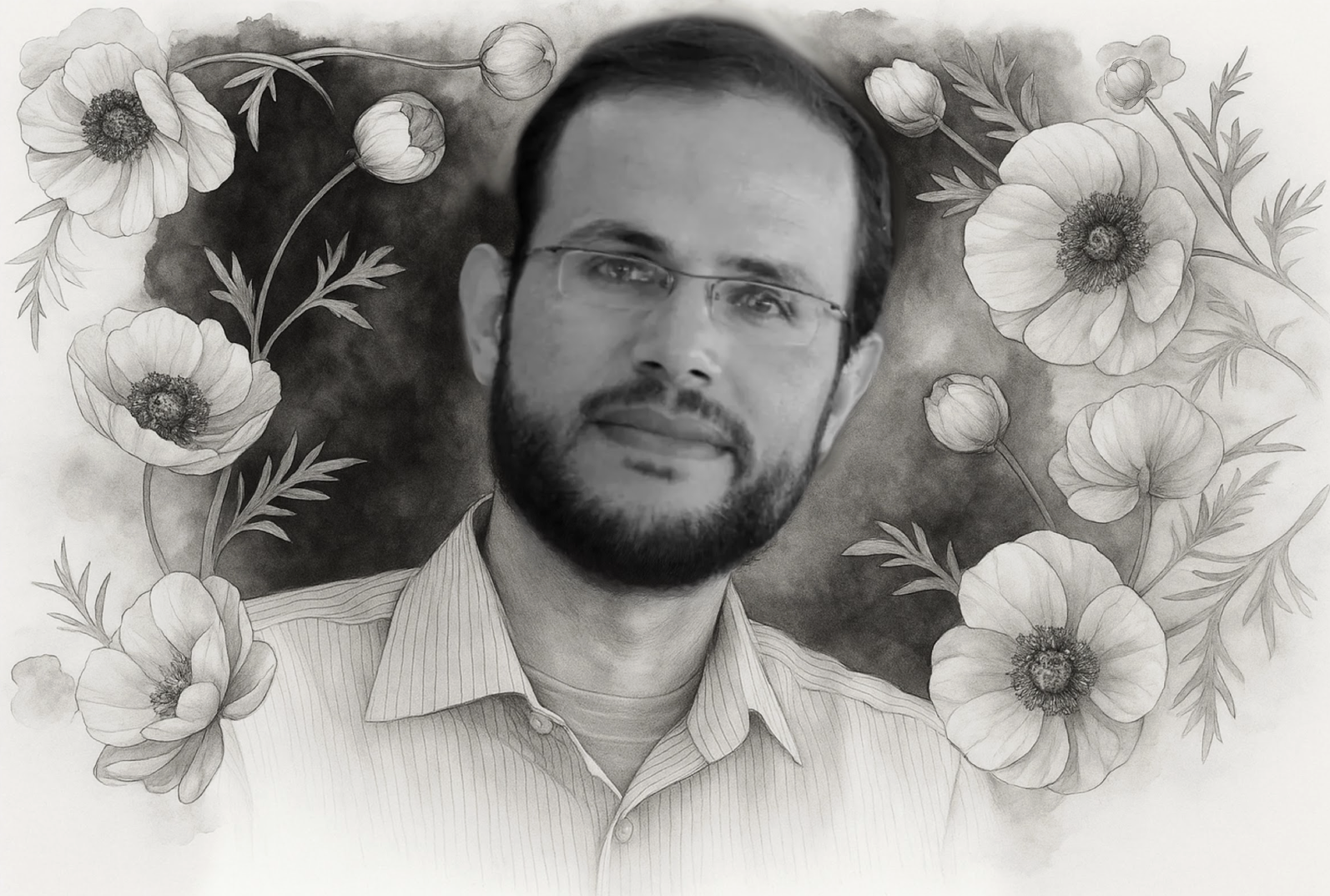
Refaat Alareer was our mentor and big brother. He was always there for us, whether it was traching us a class, treating us to dessert, writing us a recommendation letter, offering us a free creative writing course, or encouraging us to be the best versions of ourselves. "You have a story that deserves to be told," he would remind us. Sometimes, he encouraged us to be critical, even of our own beliefs. He felt triumph when we chose Shylock over Antonio in The Merchant of Venice.
While in Gaza, Refaat trained hundreds of young writers in storytelling. In 2013, he edited Gaza Writes Back. Refaat was proud to include the voices of fifteen young people in the collection, twelve of whom were women. When asked how he defined "young," he told his publisher and long-time friend, Helena Cobban, "My age or younger." Refaat's dark sense of humor meant that we would always laugh and learn when we were with him.
Refaat was young when he began his teaching career at age 23 as a teaching assistant at the Islamic University of Gaza. He edited Gaza Writes Back at the age of 33. He became a grandfather at 44, but he didn't live long enough to see his first grandchild, Abdulrahman. Israel murdered Refaat two months prior to the birth of Abdulrahman, on December 6, 2023. Refaat wrote If I Must Die for his daughter, Shaymaa, who inspired him to edit Gaza Writes Back too. Israel also murdered Shaymaa, her son Abdulrahman, and her husband in April 2024.
Refaat first wrote the poem If I Must Die in November 2011 and pinned it to his X account in November 2023 when smear campaigns against him began, led by people like Bari Weiss. The poem speaks to all of us, serving as Refaat's will to his daughter, who has also passed away. It is a call to action, urging us to tell Refaat's story and continue discussing Gaza and Palestine. Refaat's story is Gaza's story. It is everyone's responsibility to share it and turn it into an immortal tale of a people's quest for freedom.
Today, Refaat's legacy lives on through his students — an army of young writers who continue to tell Gaza's story. Hundreds of his students have become writers, professionals, and academics around the world. Whenever I speak about Gaza, someone who knew Refaat or took a class with him is usually in the audience. I have never come across a poem as globally famous as "If I Must Die." With 250 translations and millions of readers, it has become the most famous poem of the 21st century.
Here is Refaat again, "rising above others," as someone who wrote a review of Gaza Writes Back once described him. Refaat would joke about "rising above others" with me and Rawan when we toured the U.S. in 2014 to discuss the book. I can't think of a better way to describe the reaction to the poem after Refaat was murdered by an Israeli missile that also killed his brother, sister, and four nephews and nieces, Refaat's rising above people who wanted him dead.
Refaat loved Malcolm X and would often quote him. Like Malcolm X, Refaat was our prince, Gaza's prince par excellence. He loved his homeland more than anyone else, staying in Gaza to tell its tale. The tales of Gaza and Refaat merged into one: a tale of legacy, love, and resistance against a brutal, genocidal war that aimed to erase Gaza and Refaat. But the opposite happened. Gaza became a symbol of global resistance against tyranny, and Refaat became an immortal figure who refuses to be silenced.
If I must die,
You must live
To tell my story
A student of Refaat and the editor of If I Must Die: Poetry and Prose